
Showing posts with label metrology. Show all posts

Monday, 1 July 2019

The International System of Units (SI)


2019 redefinition of the SI base units - Wikipedia 


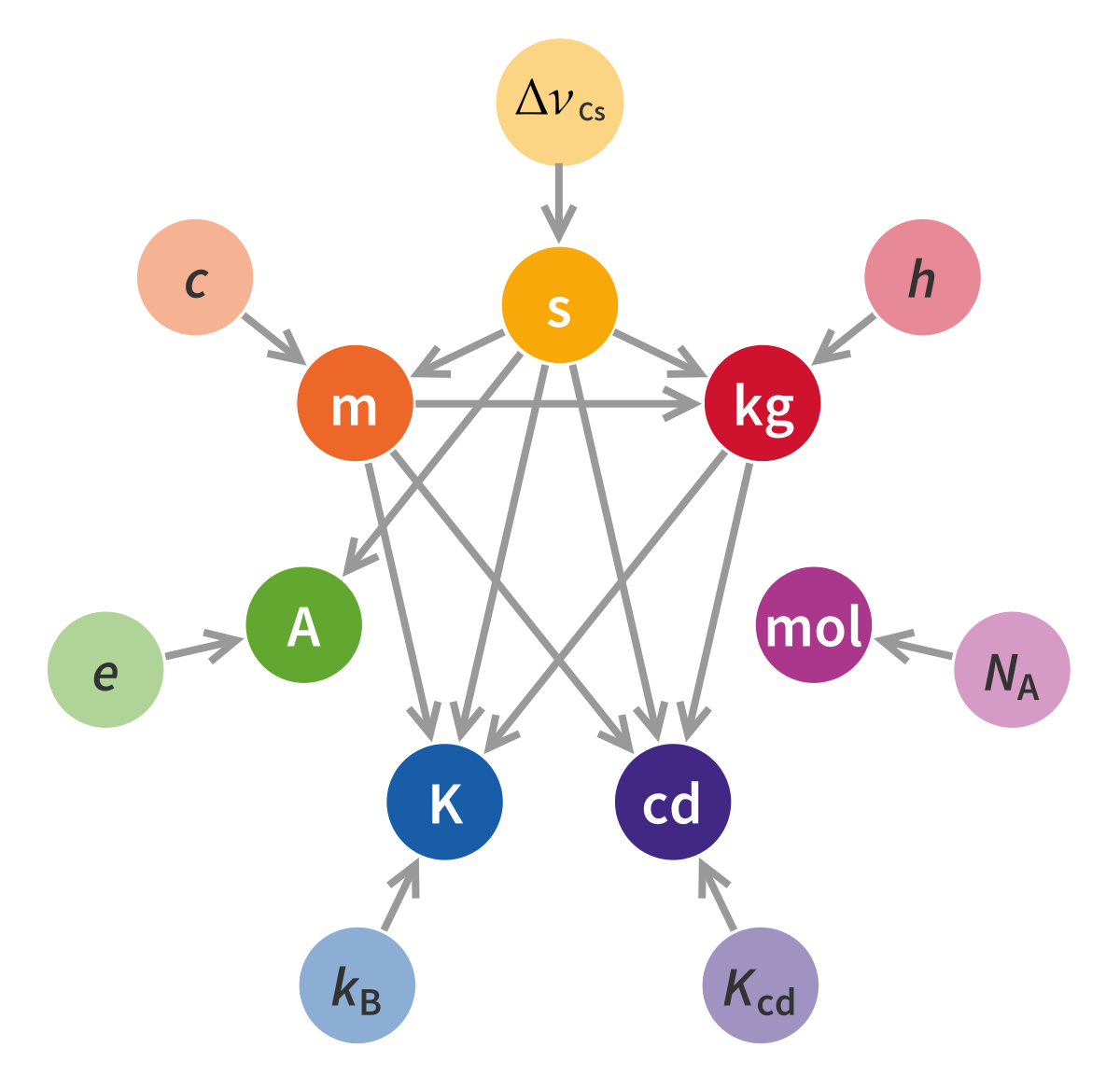
From 20 May 2019 all SI units are defined in terms of constants that describe the natural world. This assures the future stability of the SI and opens the opportunity for the use of new technologies, including quantum technologies, to implement the definitions.

The SI is the system of units in which:

  • the unperturbed ground state hyperfine transition frequency of the caesium-133 atom ΔνCs is 9 192 631 770 Hz
  • the speed of light in vacuum c is 299 792 458 m/s
  • the Planck constant h is 6.626 070 15 x 10–34 J s
  • the elementary charge e is 1.602 176 634 x 10–19 C
  • the Boltzmann constant k is 1.380 649 x 10–23 J/K
  • the Avogadro constant NA is 6.022 140 76 x 1023 mol–1
  • the luminous efficacy of monochromatic radiation of frequency 540 x 1012 Hz, Kcd, is 683 lm/W
 Source:www.bipm.org


Friday, 20 May 2016

A world without Metrology


For the occasion of World Metrology Day (20/5/2016) VSL has developed an animation in which you see what would happen if there would be NO metrology.


Source: www.vsl.nl

Thursday, 5 May 2016

Metrology in the field of Time: UTC, GMT, UT and leap seconds

The unit of time, the second, was at one time considered to be the fraction 1/86 400 of the mean solar day. The exact definition of "mean solar day" was left to the astronomers. However measurements showed that irregularities in the rotation of the Earth made this an unsatisfactory definition.

Nowadays the second is defined as  the duration of 9 192 631 770 periods of the radiation corresponding to the transition between the two hyperfine levels of the ground state of the caesium133 atom.

Time is calculated for the world by the BIPM, based on data collected from the world's most accurate clocks, which are developed by national laboratories to realize the SI second at the highest level. Collectively these clocks allow the construction of the international reference time scale (UTC), and individually they also provide essential tools for studies of fundamental physics.  

Greenwich Mean Time (GMT) is often interchanged or confused with Coordinated Universal Time (UTC). But GMT is a time zone and UTC is a time standard. 

Universal Time (UT) is also a time standard based on Earth's rotation. It is a modern continuation of Greenwich Mean Time (GMT), i.e., the mean solar time on the Prime Meridian at Greenwich, London, UK. 

The time correction DUT1 (sometimes also written DUT) is the difference between Universal Time (UT1), which is defined by Earth's rotation, and Coordinated Universal Time (UTC), which is defined by a network of precision atomic clocks.

UTC is maintained via leap seconds, such that DUT1 remains within the range −0.9 s < DUT1 < +0.9 s. The reason for this correction is partly that the rate of rotation of the Earth is not constant, due to tidal braking and the redistribution of mass within the Earth, including its oceans and atmosphere, and partly because the SI second (as now used for UTC) was already, when adopted, a little shorter than the current value of the second of mean solar time. 
 
Since this system of correction was implemented in 1972, 26 leap seconds have been inserted, the most recent on June 30, 2015 at 23:59:60 UTC. The irregularity and unpredictability of UTC leap seconds is problematic for several areas, especially computing
 

Tuesday, 30 December 2014

EURAMET - Calibration guides


The European Association of National Metrology Institutes (EURAMET) is a Regional Metrology Organisation (RMO) of Europe. It coordinates the cooperation of National Metrology Institutes (NMI) of Europe in fields like research in metrology, traceability of measurements to the SI units, international recognition of national measurement standards and related Calibration and Measurement Capabilities (CMC) of its members.

EURAMET has published a series of calibration guides which are intended to improve harmonisation in the calibration of measuring instruments.

The following guides are available: 


Saturday, 27 December 2014

Revision of the SI scheduled for 2018

At its 25th meeting (November 2014) the General Conference on Weights and Measures (CGPM) adopted a Resolution on the future revision of the International System of Units.

In the "New SI" four of the SI base units – namely the kilogram, the ampere, the kelvin and the mole – will be redefined in terms of constants; the new definitions will be based on fixed numerical values of the Planck constant (h), the elementary charge (e), the Boltzmann constant (kB), and the Avogadro constant (NA), respectively. Further, the definitions of all seven base units of the SI will also be uniformly expressed using the explicit-constant formulation, and specific mises en pratique will be drawn up to explain the realization of the definitions of each of the base units in a practical way. It was desided that despite this progress the data produced till now do not yet appear to be sufficiently robust for the CGPM to adopt the revised SI at its 25th meeting

The CGPM encourages the continued effort by the CIPM, together with its Consultative Committees, the NMIs, the BIPM, and other organizations such as the International Organization of Legal Metrology (OIML), to complete all work necessary for the CGPM at its 26th meeting (2018) to adopt a resolution that would replace the current SI with the revised SI, provided the amount of data, their uncertainties, and level of consistency are deemed satisfactory.

 An important date to note is the closing date for the publication of new data to be considered by the CODATA Task Group on Fundamental Constants for the special adjustment of the fundamental constants in preparation for the redefinition. New results for inclusion in this adjustment must be accepted for publication by 1 July 2017.

A roadmap for the redifinition of units is available here

Source: www.bipm.org 


Friday, 26 December 2014

The World's Smallest Snowman by NPL


NPL has created a snowman that measures just 10μm wide - one fifth the width of a human hair.
The snowman was made from two tin beads used to calibrate electron microscope astigmatism. The eyes and smile were milled using a focused ion beam, and the nose, which is under 1 µm wide (or 0.001 mm), is ion beam deposited platinum.

A nanomanipulation system was used to assemble the parts 'by hand' and platinum deposition was used to weld all elements together. The snowman is mounted on a silicon cantilever from an atomic force microscope whose sharp tip 'feels' surfaces creating topographic surveys at almost atomic scales.