Showing posts with label Uncertainty. Show all posts

Wednesday, 5 January 2022

New Guide on performance and uncertainty in qualitative analysis


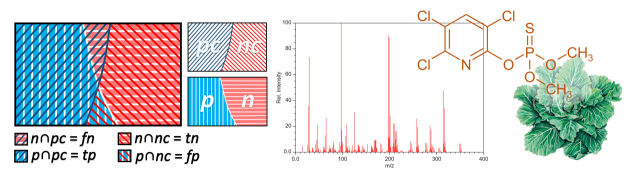
Mass spectrum, pesticide and foodstuff with Venn diagram showing false response probabilities

The Eurachem/CITAC joint qualitative analysis working group is pleased to announce the release of a new guide on "Assessment of performance and uncertainty in qualitative chemical analysis".

Qualitative analysis is analysis that returns a classification rather than a numerical value. Typical qualitative analyses determine the identity of a chemical substance, the type of plastic of a microparticle, the source of an oil spill, or the presence of accelerant in fire debris. The information used in these determinations can be qualitative, such as the response to a spot test, or can include quantitative information such as line frequences and intensities in IR or NMR spectorscopy, or mass/charge ratios in mass spectrometry. This new Eurachem/CITAC guide aims to provide some tools to help improve the quality of qualitative analysis and of their interpretation.

To help assess performance of qualitative procedures, the guide provides common measures of performance for qualitative analysis and gives experimental and other strategies for estimating performance. It includes brief recommendations for ensuring that any measurements undertaken in the course of a qualitative analysis are reliable.

Although the guide does not make recommendations on whether or not laboratories should routinely report information on the confidence associated with qualitative analysis results, the guide does describe some key metrics that can be used to convey the confidence (or uncertainty) in qualitative conclusions.

The guide is available at no charge from the Eurachem website.


Source: www.eurachem.org

Monday, 5 June 2017

Treatment of an observed bias: New leaflet issued by EURACHEM

An information leaflet has been prepared by the Eurachem Measurement Uncertainty and Traceability Working Group concerning the treatment of an observed bias. The leaflet discusses whether or not an observed significant bias should be corrected and the impact this may have on the measurement uncertainty (MU). The leaflet does not describe how to apply a correction or how to increase the uncertainty to take account of an uncorrected bias, though it does provide relevant literature sources.  

View the leaflet in English (pdf, 354 kB)

Source: www.eurachem.org

Friday, 4 March 2016

Using repeated measurements to improve the standard uncertainty


Analysts often take multiple observations, and sometimes average the result of several observations to reduce the uncertainty associated with random variation. However, it is often unclear how the standard uncertainty associated with averaged results should be calculated from an observed standard deviation. Sometimes one should divide by the square root of the number of observations; sometimes the standard deviation is used unchanged, and sometimes some alternative formula is appropriate.

This information leaflet has been prepared by the Eurachem Measurement Uncertainty and Traceability Working Group to give further explanation of when the classical 'root n' formula can, and can not, be used. The leaflet amplifies principles described in the Eurachem Guide "Quantifying uncertainty in analytical measurement", which is available here.


Source: www.eurachem.org

Thursday, 13 February 2014

Calibration of Standard Capacity Measures using the Volumetric Method

Due to the lack of international documentation on calibration of volume measurements using the volumetric method the EURAMET TC-Flow decided to create guidelines and to harmonize procedures and concepts in that field of metrology. The first calibration guide for volume measurements using the volumetric method: EURAMET Calibration Guide 21 includes several topics: 
  • Specific definitions related with volumetric calibration,
  • General techniques, such as ambient and water calibration conditions, cleaning, meniscus adjustment and expansion coefficient of water,
  • The calibration procedure using the filling method and using the withdrawing method,
  • The mathematic equation for determination of volume,
  • The procedure for estimating measurement uncertainty and
  • A practical case study is described. 
Main users of this guide will be accredited laboratories, industry and national metrology laboratories that are performing measurements on volume of liquid.

The Guide is available for downloading here

Source: www.euramet.org 

Saturday, 21 December 2013

Sampling Uncertainty


The aim of sampling is to obtain a small portion of material (sample) from a selected system (sampling target) within a container which is representative of the material in that system. The sampling process should ensure that the sample is an unbiased reflection of the composition of the sampling target.  
Sampling becomes extremely important when considering the uncertainty of measurement. Until recently a “metrological gap” existed between analysts and end-users concerning the interpretation of measurement results and their associated uncertainties. Analysts concentrated on the analytical measurement process and estimated the uncertainty of the measurand of the sample received at the laboratory while the end user naturally interpreted the measurement result together with its uncertainty in order to characterize the sampling target as a whole. Therefore, the end user needs to know a precise estimate of an uncertainty that includes the uncertainty caused by sampling i.e. the combined uncertainty from sampling and analysis.  

Sampling uncertainty is defined as the part of the total measurement uncertainty attributable to sampling. Principles and procedures for estimating the uncertainty of measurement arising from sampling are described in the Guide published by Eurachem and CITAC as well as in the Nordtest handbook, which is intended for practical applications.    

Thursday, 3 January 2013

The role of measurement uncertainty in conformity assessment

The JCGM Working Group 1 (JCGM-WG1) produced and issued one more documnet to accompany the GUM.  The  Evaluation of measurement data – The role of measurement uncertainty in conformity assessment (JCGM 106:2012) has been approved and is available for download as PDF file in http://www.bipm.org/en/publications/guides/gum.html . This document provides guidance and procedures for assessing the conformity of an item (entity, object or system) with specified requirements. The procedures developed in this document can be used to realize an interval, called an acceptance interval, of permissible measured values of the property of interest. Acceptance limits can be chosen so as to balance the risks associated with accepting non-conforming items (consumer's risk) or rejecting conforming items (producer's risk).


Sunday, 28 October 2012

Quantifying Uncertainty in Analytical Measurement, 3rd Edition (2012)

This guide has been produced by a joint EURACHEM/CITAC Measurement Uncertainty Working Group.
Cause and Effect diagramThe first edition of the EURACHEM Guide for “Quantifying Uncertainty in Analytical Measurement” was published in 1995 based on the ISO "Guide to the Expression of Uncertainty in Measurement". The second edition was prepared in collaboration with CITAC in 2000 in the light of practical experience of uncertainty estimation in chemistry laboratories and the even greater awareness of the need to introduce formal quality assurance procedures by laboratories. The second edition stressed that the procedures introduced by a laboratory to estimate its measurement uncertainty should be integrated with existing quality assurance measures, since these measures frequently provide much of the information required to evaluate the measurement uncertainty.
This third edition retains the features of the second edition and adds information based on developments in uncertainty estimation and use since 2000. The additional material provides:
  • Improved guidance on the expression of uncertainty near zero; Monte Carlo uncertainty evaluation
  • New guidance on the use of Monte Carlo methods for uncertainty evaluation;
  • Improved guidance on the use of proficiency testing data:
  • Improved guidance on the assessment of compliance of results with measurement uncertainty.
The guide therefore provides explicitly for the use of validation and related data in the construction of uncertainty estimates in full compliance with the formal ISO Guide principles set out in the ISO Guide to the Expression of Uncertainty in measurement. The approach is also consistent with the requirements of ISO/IEC 17025:2005.

Source: www.eurachem.org

Monday, 16 April 2012

International vocabulary of metrology (VIM) corrected 3rd edition - 2012

One of the most important events in the last decade for the future of measurement is the third edition of the International Vocabulary of Metrology, commonly called ‘‘VIM’’ (from the French title ‘‘Vocabulaire International de Metrologie’’). The corrected version (2012) of the third edition of the VIM has been approved by each and all of the eight JCGM Member organizations and is available at http://www.bipm.org/en/publications/guides/vim.html.

Sunday, 10 July 2011

Eurachem draft revised Uncertainty Guide released

The second edition of the EURACHEM/CITAC Guide for quantifying uncertainty in analytical measurements, published in 2000, is the most cited document in Metrology in Chemistry. The success of this document is based on the balance of the clarity and detail of technical discussions with the pragmatism of the proposed solutions for the evaluation of the measurement uncertainty. After a decade of developments supported on the principles presented and introduced by the EURACHEM/CITAC Guide, this document is being revised and updated to take account of new terminology and recent developments in measurement uncertainty evaluation.

To support discussion at the Eurachem/CITAC Workshop "Recent developments in Measurement Uncertainty", the Eurachem/CITAC measurement Uncertainty and Traceability Working Group have released a first discussion draft of the proposed revision of "Quantifying Uncertainty in Analytical measurement".

The draft Guide is available at http://eurachem.org/guides/pdf/QUAM2011_DIS1.pdf

Source: www.eurachem.org

Saturday, 2 April 2011

Eurachem Workshop: Recent developments in Measurement Uncertainty: The new Eurachem/CITAC Guide

The EURACHEM/CITAC Measurement Uncertainty and Traceability Working Group invites you to participate in the next EURACHEM workshop to be held in Lisbon, between the 6th and the 7th June 2011. The event will be jointly organised by EURACHEM Portugal and RELACRE, the Portuguese Association of Accredited Laboratories, representing EUROLAB. Discussion of recent developments in measurement uncertainty evaluation will take place in the frame of the proposed revision of the Eurachem/CITAC guide “Quantifying Uncertainty in Analytical Measurement”.

Tuesday, 18 January 2011

Comparison of ISO-GUM and Monte Carlo methods for the evaluation of measurement uncertainty

An article of D. Theodorou et al. under the title:


Comparison of ISO-GUM and Monte Carlo methods for the evaluation of measurement uncertainty: Application to direct cadmium measurement in water by GFAAS


was recently published in Talanta journal (Talanta 83(2011) 1568-1574). The work published presents two approaches for the estimation of the uncertainty of the direct determination of cadmium in water by graphite furnace atomic absorption spectrometry (GUM Uncertainty Framework and Monte Carlo Simulation Method).


Abstract


The propagation stage of uncertainty evaluation, known as the propagation of distributions, is in most cases approached by the GUM (Guide to the Expression of Uncertainty in Measurement) uncertainty framework which is based on the law of propagation of uncertainty assigned to various input quantities and the characterization of the measurand (output quantity) by a Gaussian or a t-distribution. Recently, a Supplement to the ISO-GUM was prepared by the JCGM (Joint Committee for Guides in Metrology). This Guide gives guidance on propagating probability distributions assigned to various input quantities through a numerical simulation (Monte Carlo Method) and determining a probability distribution for the measurand.


In the present work the two approaches were used to estimate the uncertainty of the direct determination of cadmium in water by graphite furnace atomic absorption spectrometry (GFAAS). The expanded uncertainty results (at 95% confidence levels) obtained with the GUM Uncertainty Framework and the Monte Carlo Method at the concentration level of 3.01 μg/L were ±0.20 μg/L and ±0.18 μg/L, respectively. Thus, the GUM Uncertainty Framework slightly overestimates the overall uncertainty by 10%. Even after taking into account additional sources of uncertainty that the GUM Uncertainty Framework considers as negligible, the Monte Carlo gives again the same uncertainty result (±0.18 μg/L). The main source of this difference is the approximation used by the GUM Uncertainty Framework in estimating the standard uncertainty of the calibration curve produced by least squares regression. Although the GUM Uncertainty Framework proves to be adequate in this particular case, generally the Monte Carlo Method has features that avoid the assumptions and the limitations of the GUM Uncertainty Framework.


Full text available at: doi:10.1016/j.talanta.2010.11.059

Wednesday, 28 April 2010

Measurement Uncertainty and Compliance Assessment

Results of chemical analyses are often used as a basis for important decisions and judgements (e.g. compliance or non-compliance of product or sample with a specification). The way the results of measurements are presented should make the decision making process easier for the end-user of the results. Therefore, in order to utilize correctly a result, it is necessary to take into account the measurement uncertainty. Measurement uncertainty, when evaluated correctly, gives a more realistic estimate of the true spread of results. Knowing the uncertainty, provides confidence to the analyst and the customer that decisions based on the results are being made with full knowledge of the range within which the true value lies.

A work about this subject was presented at the 3rd International Conference “AQUA 2008” on Water Science and Technology. Aqua Presentation